


A Mylar sheet is a thin and bendy film made from polyester. You can find it in many places because it is strong and clear. It also blocks water and air very well. People who do crafts use Mylar sheets for stencils and decorations. They also use them for Die-Cutting Mylar Film to make exact shapes. In packaging, Mylar helps keep food fresh and safe. Insulating Mylar sheet choices can protect things from heat and light. This makes them good for daily projects and important storage needs.
Key Takeaways
- Mylar sheets are strong and bendy polyester films. They block water, air, and light very well. They come in different thicknesses and shapes. You can use them for crafts, packaging, insulation, and technical things. Mylar does not get damaged by heat, chemicals, or tearing. This makes it last a long time for many projects and storage. Clear Mylar keeps things safe but lets you see them. It is great for artwork, papers, and food packaging. People use Mylar in food storage to keep snacks fresh. It blocks moisture and oxygen. Artists use Mylar to make stencils they can use again. They also use it for mixed media because it bends but does not break. Emergency blankets and face shields use Mylar too. It helps reflect heat and gives protection. Pick the right thickness and size for your project. Store Mylar flat or rolled to keep it nice.
Mylar Sheet Overview
What is Mylar
You might ask why Mylar is different. Mylar is a plastic film made from PET. PET stands for polyethylene terephthalate. People make Mylar by stretching it in two ways. This makes Mylar strong and bendy. Mylar does not react with most chemicals. It keeps its shape in hot or cold places. Scientists say Mylar is a good electrical insulator. It has high permittivity and resists electrical breakdown. These things help in electronics, packaging, and art projects.
Tip: Mylar works well with changes in heat and wetness. You can use it in many places.
History and Naming
Mylar started in the early 1950s. DuPont Teijin Films made it as a safe film. In 1955, Eastman Kodak used Mylar for photo film. It helped with long flights that needed strong, light stuff. NASA used Mylar in the Echo II balloon in the 1960s. This showed it was good for space. By the late 1970s, people liked Mylar for shiny balloons and party things. Over time, people called any clear polyester film “Mylar,” even if it was not the brand. Today, you see Mylar in packaging, electrical work, and saving papers. Archivists use Mylar encapsulation to protect old papers. They put papers between two Mylar sheets to keep them safe from harm and bugs.
Forms and Thickness
Mylar comes in many shapes and thicknesses. Factories buy it in big rolls and spools. You might see it as emergency blankets, balloons, or shiny foil. Mylar sheet thickness goes from 1 micron to 350 microns. Even thin sheets are strong and do not rip easily. You can cut Mylar by hand or with machines. You can join pieces by heat sealing. Some Mylar films are almost clear. Others look cloudy. For example:
- Mylar type-D sheets are thin (70–250 microns) and almost see-through.
- Mylar type-A sheets are thick (250 microns and up) and look very cloudy.
The thickness changes how clear the sheet looks. Makers can also make Mylar in many colors, patterns, and sizes for what you need.
Composition
Material Makeup
You might ask what makes Mylar different. Scientists made Mylar from a plastic called PET. This plastic is strong and can bend without breaking. PET is also used in water bottles and medical items like Dacron. The top of Mylar has a contact angle of about 80 degrees. Water does not soak in fast, so the film stays dry and clean.
Here is a table with facts about Mylar and how it works:
| Aspect | Details |
|---|---|
| Material Composition | PET (polyethylene terephthalate), same as Dacron™ |
| Surface Wettability | Contact angle: 80.2±2.30°, moderate wetting |
| Surface Characterization | Analyzed by XPS and contact angle, similar to Dacron™ |
| Biological Performance Impact | Used for cell studies, mimics Dacron™ |
| Cell Adhesion Enhancement | Dual ligand treatment improves cell spreading and adhesion |
| Thermal Properties | Aluminized Mylar has low thermal emissivity (~0.044), great for reflecting heat |
PET gives Mylar its special features. Scientists use tests like X-ray photoelectron spectroscopy to look at the surface. Mylar is helpful in science labs. Researchers use it to help cells stick and grow in tests. If you add a thin aluminum layer, Mylar reflects heat well. This makes it good for insulation and emergency blankets.
Note: Aluminized Mylar reflects heat because it does not let much heat pass through. This helps keep things warm or cool.
Manufacturing Process
You may wonder how factories make Mylar so strong. The process has many careful steps to make the film:
- Workers start with PET chips. They dry the chips to get rid of water.
- Machines melt the PET and push it into thick sheets. The sheets cool and become a basic film.
- The film is stretched in two ways. This lines up the molecules and makes the film strong.
- The film is heated. This step locks the molecules and helps the film stay stable.
- The film is rolled up and cut into sheets or spools.
Each step helps Mylar become tough and flexible. Stretching the film in two ways is very important. This step gives Mylar its strength and helps it keep its shape. Heating the film makes sure it does not shrink or bend when used.
Tip: The careful way Mylar is made makes it better than regular plastic films. It does not tear easily, stays flat, and works in many ways.
Mylar Sheet Properties
Strength and Durability
You can count on Mylar because it is very strong. It does not tear or stretch as easily as other films. Scientists tested Mylar in hard situations. They used Mylar plates to hit strong panels at fast speeds. These tests helped them learn how things react to impacts, like space debris. The Mylar plates stayed strong and did not break. This shows that Mylar can handle sudden force and pressure. Even though the panels were the main focus, using Mylar as the impactor proved its toughness. It also showed that Mylar keeps its shape under stress.
- Mylar does not get damaged by pulling or bending.
- It stays the same even after you use it many times.
- You can use it for projects that need a tough film.
Tip: Mylar works in normal and extreme conditions. You can use it for crafts, packaging, or science experiments.
Flexibility
Mylar can bend and fold without breaking. This makes it easy to use for many things. Scientists checked how thin PET sheets, like Mylar, wrap around curved shapes. In one test, a 13-micron PET sheet covered a round object well. The sheet stayed close and did not crack or leave gaps. If you add small cuts or folds, Mylar gets even more flexible for art or electronics.
Researchers use tools to press on thin films and see how much they bend. These tests show that Mylar can bend and stretch. This is important for things like flexible screens or wearable tech. You can cut, fold, or roll Mylar. It will go back to its original shape. For precise shapes and fine details, laser cutting machines can be used to process Mylar sheets.
Chemical and Heat Resistance
Mylar can handle heat and chemicals very well. Some types of Mylar stay strong from -100°F to 300°F. You can use it in the freezer or oven and it will not get ruined. Mylar also blocks acids, oils, and soaps. It does not break down when you clean it or use it with food. You can even sterilize it with steam, radiation, or strong cleaners. It will still keep its quality.
| Property | Performance Range |
|---|---|
| Temperature Resistance | -100°F to 300°F |
| Chemical Resistance | Acids, oils, detergents, greases |
| Sterilization Methods | Steam, radiation, gas, peroxide |
Note: Mylar keeps its shape and strength even after harsh chemicals or high heat. This makes it safe for food storage, medical uses, and more.
Clarity and Barrier Qualities

When you look at a Mylar sheet, you notice how clear it can be. Many types of Mylar film let you see through them almost like glass. This clarity helps you in projects where you want to protect something but still see it. For example, you might use clear Mylar to cover artwork, posters, or important documents. You keep dust and fingerprints away, but you can still enjoy the view.
You also get strong barrier qualities with Mylar. The film blocks air, water, and even some gases. This means you can use it to keep food fresh or protect items from moisture. Many food packages use Mylar because it keeps out oxygen and water vapor. When you store snacks or coffee, the barrier keeps the flavors and smells inside. You do not have to worry about your food going stale quickly.
Here is a table that shows how Mylar compares to other common films:
| Property | Mylar (PET) | Polyethylene | PVC | Cellophane |
|---|---|---|---|---|
| Clarity | High | Medium | High | Medium |
| Water Barrier | Excellent | Good | Poor | Poor |
| Oxygen Barrier | Excellent | Poor | Poor | Good |
| Smell Barrier | Excellent | Poor | Poor | Good |
You can see that Mylar stands out for both clarity and barrier strength. You get the best of both worlds: you can see what you protect, and you keep it safe from air and water.
Tip: If you want to store something for a long time, choose a film with a strong barrier. Mylar works well for this job.
You also find Mylar used in science labs and museums. Archivists use it to wrap old papers and photos. The clear film lets you study the item without touching it. You protect the item from dirt, bugs, and moisture. In crafts, you can use clear Mylar as a stencil or a window in a card. You get a smooth, see-through surface that does not tear easily.
Some Mylar films have a shiny, mirror-like finish. These reflect light and heat. You see this in emergency blankets and some packaging. The shiny side bounces light away, which helps keep things cool or warm as needed.
You can cut or fold Mylar without losing its clarity. The film does not turn cloudy or yellow over time. This makes it a good choice for projects that need to last.
Uses of Mylar Sheet

Packaging
Food and Snack Storage
You see Mylar sheets used in many food packages at the store. Companies choose this material because it keeps snacks fresh for a long time. The film blocks air and moisture, so chips, nuts, and dried fruit stay crisp and tasty. You can also use Mylar bags at home to store rice, beans, or pasta. When you seal the bag, you protect your food from bugs and mold. Many people who prepare for emergencies use Mylar bags to keep food safe for years.
- Mylar sheets help keep out oxygen and water.
- You can use them for both short-term and long-term storage.
- The film does not let smells escape, so your pantry stays fresh.
Tip: If you want to store food for a long time, use a Mylar bag with an oxygen absorber. This keeps your food safe and tasty.
Coffee and Specialty Packaging
Coffee companies use Mylar sheets to keep beans fresh. The film blocks light, air, and moisture, which can ruin the flavor. Specialty teas and spices also come in Mylar packaging. You get a strong barrier that keeps out unwanted smells and keeps in the rich aroma. Some packages use a shiny, metallized Mylar layer for extra protection. This helps your coffee taste fresh every time you open the bag.
- Mylar packaging keeps flavors and smells inside.
- The film protects against light and air.
- Specialty foods stay fresh longer in Mylar bags.
You find Mylar sheets in many other packaging uses. Companies use them for medicines, electronics, and even drinks. Reports show that Mylar packaging is popular because it is strong, flexible, and easy to print on. The market for Mylar packaging keeps growing. People want packaging that is safe, eco-friendly, and easy to customize.
Crafts and Stencils
Stencil Making
You can use Mylar sheets to make your own stencils for art and crafts. Many artists and crafters like 10mil Mylar because it is flexible and strong. You can trace a design on the sheet, cut it out, and use it again and again. Mylar stencils work well for painting walls, making signs, or decorating cakes. The film bends without breaking, so you can use it on flat or curved surfaces.
- Mylar stencils last a long time if you clean them after use.
- You can cut fine details for sharp, clear designs.
- Both hobbyists and professionals use Mylar for stencils.
Note: Mylar stencils are reusable and easy to clean. You save time and money by using the same stencil for many projects.
Mixed Media Art
Artists use Mylar sheets in mixed media projects. You can draw, paint, or print on the film. Some artists layer Mylar over other materials to create depth and shine. The clear film lets you see the layers below, so you can build up interesting effects. Mylar does not tear easily, so you can cut it into shapes or use it as a base for collage.
- Mylar works with markers, paints, and inks.
- You can use it for tracing, overlays, or as a protective cover.
- The film stays flat and smooth, even after many uses.
Many craft communities recommend Mylar for its strength and flexibility. You can use it for small, detailed work or large projects like murals and floor designs.
Insulation and Protection
Emergency Blankets
You may have seen shiny, silver blankets in first aid kits. These are emergency blankets made from Mylar sheets. The film reflects your body heat back to you, helping you stay warm if you get cold. Hikers, campers, and rescue workers carry these blankets because they are light and easy to pack. You can also use them to make a shelter or signal for help.
- Mylar emergency blankets keep you warm by reflecting heat.
- The blankets are waterproof and windproof.
- You can fold them up and carry them in your pocket.
Tip: Always keep a Mylar emergency blanket in your car or backpack. It can help you stay safe in cold weather.
Face Shields and Barriers
During the COVID-19 pandemic, people used Mylar sheets to make face shields. The clear film protects your face from droplets and splashes. You can cut the sheet to fit your head and attach it to a headband. Mylar is light and does not fog up easily, so you can wear it for a long time. Hospitals and schools used Mylar barriers to separate people and stop the spread of germs.
- Mylar face shields are clear and easy to clean.
- You can reuse them after washing with soap and water.
- The film is strong but light, so it feels comfortable.
You also find Mylar used as a barrier in science labs and factories. The film protects people and equipment from dust, chemicals, and germs.
Industrial and Technical
Electrical Insulation
You can find Mylar sheets in many electronic devices. These sheets work as insulators. That means they stop electricity from moving through them. You see Mylar inside transformers and cables. It also goes in capacitors. Mylar keeps electricity from leaking out. This helps devices stay safe and work well. The film stays strong when it gets hot or meets chemicals. That is why it is good for protecting wires and parts.
Engineers like Mylar sheets because they are thin and tough. You can wrap them around wires. You can also use them as layers inside machines. Mylar does not break down fast, so it lasts a long time. You also see Mylar in batteries and circuit boards. It keeps parts apart and stops short circuits.
Mylar sheets help make permanent records for buildings and machines. The Secretary of the Interior’s Guidelines say to use archival materials like Mylar sheets for measured drawings. This means people trust Mylar for important technical work. Architects and engineers use these sheets to keep records safe for many years.
Reflective Surfaces
You see Mylar sheets used as shiny surfaces in many places. The shiny side bounces light and heat away. This helps in lighting, solar panels, and greenhouses. If you line a grow room or lamp with Mylar, you get more light where you want it. This helps plants grow better or makes a room brighter.
Factories use Mylar sheets to make mirrors and shiny coatings. The film is light and easy to use. You can cover big spaces without much trouble. Mylar does not rust or fade, so it keeps shining for a long time. You also find Mylar in insulation for buildings and cars. The shiny layer keeps heat inside in winter and outside in summer.
Some technical products use films like Mylar with other coatings. These films mix strong plastics with PTFE or fiberglass. You find them in conveyor belts and food processing. They are also in anti-static mats. These materials resist chemicals and heat, so they work well for tough jobs.
Tip: If you need a surface that bounces light or heat, try a Mylar sheet. It is easy to cut and attach, and it lasts a long time.
Comparison
Mylar vs. Plastic Sheets
When you look at Mylar and plastic sheets, you see big differences. Mylar is flexible and has a strong barrier. You can bend and fold Mylar without it breaking. Regular plastic sheets, especially stiff ones, do not bend well. They can crack if you try to fold them. Mylar keeps out water, air, and light better than most plastic sheets. This helps keep food fresh and safe.
Here is a table to show the differences:
| Property/Aspect | Mylar (BoPET Film) | Rigid Plastic Sheets (Rigid Packaging) |
|---|---|---|
| Flexibility | Strong yet flexible; easy to customize | Sturdy but less flexible; not easy to shape |
| Barrier Properties | Excellent against moisture, air, and light | Good physical protection, but weaker barrier |
| Tensile Strength | High; resists tearing and punctures | Durable, but more rigid |
| Environmental Impact | Recyclable, not biodegradable | Sometimes biodegradable, often recyclable |
| Cost | Lower cost | Higher cost |
| Consumer Preference | Chosen for freshness and protection | Chosen for sturdiness |
Mylar is light and tough. It keeps things fresh. Plastic sheets are good for strong packaging. But they do not block air or water as well.
Mylar vs. Aluminum Foil
You may wonder how Mylar and aluminum foil compare. Both reflect light and heat, but they act differently. Mylar keeps its shine even if you bend it. Aluminum foil loses some shine when it gets wrinkled. Mylar works the same no matter how you place it. Foil works best in certain ways.
Look at this table for a quick view:
| Material Type | Reflectivity (PAR 400-700 nm) | Heat Resistance & Safety | Practical Notes & Usage |
|---|---|---|---|
| Reflective Mylar | ~90-91% | Can hold a charge; may support combustion | High reflectivity; less heat resistant; used for reflectivity in grow rooms |
| Aluminum Foil | ~55% (drops to ~35% if creased) | Self-extinguishing; better heat dissipation | Lower reflectivity in practice; creates hotspots; harder to attach |
| Plastic Sheets | White: 75-90%; Black: blocks light | Melts if too close to heat | Useful for temporary setups; moderate reflectivity |
Mylar is great for grow rooms and projects that need steady light. Aluminum foil can make hot spots and is hard to keep smooth. Mylar also works well in solar panels. It gives steady results no matter how you use it.
Unique Advantages
You get many special benefits with Mylar. Here are some reasons people use it:
- Mylar bags keep out water, light, and air, so food stays fresh.
- You can add logos, labels, and shapes to Mylar packaging.
- Mylar is light and saves space, so storage is easy.
- The film is airtight and keeps out bugs and mice.
- Mylar blocks UV light, which helps protect sensitive things.
- NASA uses Mylar in space suits because it is strong and safe.
- Mylar bags last longer than vacuum bags, which can lose their seal.
- Black Mylar blocks all light for extra safety.
- Stand-up pouches made from Mylar are easy to display and keep things fresh with resealable tops.
Tip: If you want packaging that keeps things fresh, blocks light, and saves space, Mylar is a smart pick.
Safety and Environment
Food Safety
You can trust Mylar for many food storage needs. The material does not react with most foods. It does not add any taste or smell. You often see it used for packaging snacks, coffee, and dried goods. The film blocks air and moisture, which helps keep food fresh. You should always use food-grade Mylar if you plan to store food. Look for packaging that says “food safe” or “meets FDA standards.” This ensures your food stays safe and uncontaminated. If you use Mylar for long-term storage, add oxygen absorbers to prevent spoilage. Always check for any damage or holes before sealing food inside.
Handling and Cleaning
You need to handle Mylar with care to keep it in good shape. The film can attract dust because of static electricity. You can gently rub the surface to remove dust or fine eraser bits. Use soft, non-abrasive materials for cleaning. Avoid using Mylar on powdery or fragile surfaces, as this can cause damage. Mylar works well as a shield when you clean delicate items. It protects edges and surfaces from tearing. When you clean, start at the center and move toward the edges. If you find a tear, clean along the tear, not across it. This helps prevent further damage.
- Gently wipe dust away with a soft cloth.
- Do not use harsh chemicals or rough sponges.
- Keep Mylar away from sharp objects to avoid scratches.
- Store flat or rolled to prevent creases.
Tip: Always test your cleaning method on a small area first. This helps you avoid unwanted damage.
Recycling and Disposal
You can recycle Mylar in some areas, but not all recycling centers accept it. Mylar is a type of polyester, so check with your local recycling program for rules. If you cannot recycle it, place it in the regular trash. Try to reuse Mylar when possible. You can use old sheets for crafts, storage, or as protective covers. Reusing helps reduce waste and protects the environment. Never burn Mylar, as it can release harmful fumes. Always dispose of it responsibly.
| Action | Recommendation |
|---|---|
| Recycling | Check local guidelines |
| Reusing | Use for crafts or protection |
| Disposal | Place in trash if not recycled |
| Burning | Never burn Mylar |
♻️ Reuse and recycle whenever you can to help the planet.
Choosing Mylar Sheet
Thickness and Size
You need to pick the right thickness and size for your project. Thinner sheets work well for delicate tasks, like overlays or stencils. Thicker sheets give more strength for protection or insulation. You also need to think about the width and length. Some projects need long rolls, while others need small, precut circles.
Here is a table that shows some common options:
| Product Code | Thickness (µm / mil) | Format | Width (in/mm) | Length (ft/m) |
|---|---|---|---|---|
| 125 | 3.0µm (0.12mil) | Roll | 3.0″ (76.2mm) | 300′ (91.4m) |
| 250 | 6.0µm (0.24mil) | Roll | 3.0″ (76.2mm) | 300′ (91.4m) |
| 3012 | 2.5µm (0.1mil) | SpectroMembrane® | 3.0″ (76.2mm) | 100 |
| 3014-45 | 3.6µm (0.14mil) | SpectroMembrane® | 1.77″ (45mm) | 100 |
| 150 | 3.6µm (0.14mil) | Roll | 3.0″ (76.2mm) | 300′ (91.4m) |
| 3015 | 6.0µm (0.24mil) | SpectroMembrane® | 2.5″ (63.5mm) | 100 |
| 100 | 2.5µm (0.1mil) | Roll | 3.0″ (76.2mm) | 300′ (91.4m) |
| 126 | 3.0µm (0.12mil) | Precut Circles | 2.5″ (63.5mm) | 500 |
| 2020R35M3.6 | 3.6µm (0.14mil) | SpectroFilm® | 1.38″ (35mm) | 25 |
| 2014R20M6.0 | 6.0µm (0.24mil) | SpectroFilm® | 0.78″ (20mm) | 25 |
You can see that thickness ranges from 2.5µm to 6.0µm. Widths go from less than an inch to three inches. Lengths can reach up to 300 feet. Some sheets come as rolls, while others are precut for special uses.
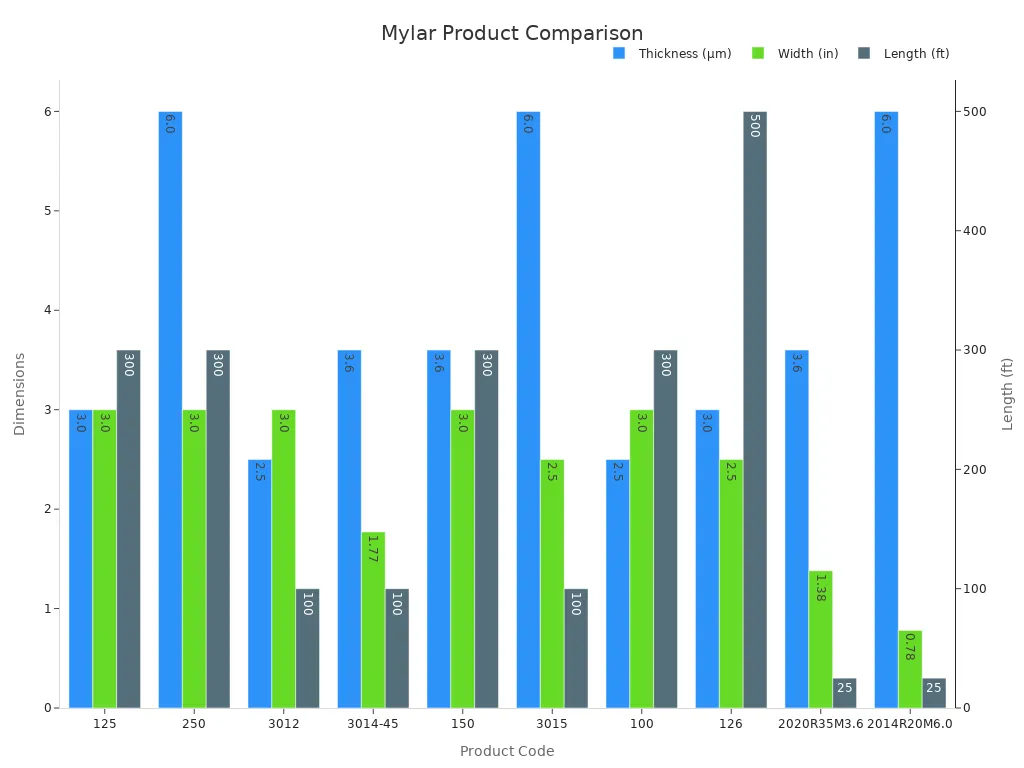
When you choose, think about what you need the sheet to do. Thin sheets let more light through and bend easily. Thick sheets protect better and last longer. You should also check if the sheet resists chemicals or fits your equipment.
Tip: Always match the thickness and size to your project. This helps you get the best results.
Where to Buy
You can find these sheets in many places. Art supply stores often carry them for crafts and stencils. Hardware stores may have them for insulation or protection. Online shops give you the most choices. You can search by thickness, size, or brand. Some websites let you order custom sizes or special coatings.
Here are some places to look:
- Art and craft stores
- Hardware and home improvement stores
- Online retailers like Amazon or specialty websites
- Scientific supply companies
When you shop, check the product details. Make sure you get the right thickness and format. Some sellers offer sample packs if you want to try different types.
Note: Always read reviews and product descriptions before you buy. This helps you avoid mistakes.
Storage Tips
You need to store your sheets the right way to keep them in good shape. Keep them flat or rolled, not folded. Folding can cause creases that do not go away. Store them in a cool, dry place. Avoid sunlight, which can make the film brittle over time.
Follow these tips for best results:
- Roll large sheets around a tube to prevent bends
- Keep sheets in a clean, dust-free container
- Store away from sharp objects that could scratch the surface
- Label your sheets by thickness and size for easy use
🗂️ Good storage keeps your sheets ready for any project. Take care of them, and they will last a long time.
You now know that a Mylar sheet offers strength, flexibility, and clear protection for many uses. You can use it for crafts, food storage, or even emergency kits. Think about what you need—thickness, size, or special features—before you choose your Mylar sheet. Try it for your next project and see how it makes your work easier and safer.
FAQ
What is the difference between Mylar and regular plastic?
You get a stronger barrier with Mylar. It blocks air, water, and light better than most plastics. Mylar also bends without breaking. Regular plastic sheets often crack or let in moisture.
Can you write or print on Mylar sheets?
Yes, you can write on Mylar with permanent markers. You can also print on some Mylar sheets using laser printers. Always check if your printer supports Mylar film before you try.
Is Mylar safe for food storage?
You can safely use food-grade Mylar for storing food. It does not react with food or add any taste. Always choose Mylar labeled as “food safe” for best results.
How do you seal a Mylar bag?
You can seal Mylar bags with a heat sealer or a household iron. Press the edges together until they stick. Make sure the seal is tight to keep air and moisture out.
Can you recycle Mylar sheets?
Some recycling centers accept Mylar, but not all do. You should check local rules. If you cannot recycle it, try to reuse it for crafts or storage before throwing it away.
Does Mylar block UV light?
Yes, Mylar blocks most UV light. You can use it to protect photos, documents, or food from sunlight. This helps prevent fading and spoilage.
What thickness of Mylar should you use for stencils?
You should use 7mil to 10mil thick Mylar for stencils. This thickness gives you a good balance of strength and flexibility. It also makes cutting and cleaning easy.
Can you cut Mylar sheets at home?
Yes, you can cut Mylar sheets with scissors, craft knives, or cutting machines. Always use a sharp blade for clean edges. Work on a safe surface to avoid damage.

