

In modern electronics manufacturing, a single electrostatic discharge can damage sensitive components during assembly or shipping, leading to costly failures and reduced yields.
Conductive foam prevents these issues by safely dissipating static charges, shielding against electromagnetic interference, and allowing precise die-cutting for custom protective inserts.
1. Why Conductive Foam Is Critical in Electronics Manufacturing
1.1. Real-World ESD and EMI Risks
Static discharges often occur unnoticed during handling, causing hidden defects that fail later in devices like smartphones or medical equipment.
Nearby signals create electromagnetic interference, disrupting performance in compact electronics.
These risks lead to higher defect rates—up to 30% in unprotected lines—and expensive recalls for manufacturers.
1.2. Why Traditional Foam Materials Fail
Standard insulating foams trap static charges, allowing sudden discharges that damage parts.
They lack conductivity, offering no shielding against interference.
Switching to conductive alternatives reduces failures, improves reliability, and ensures compliance with industry standards.
1.3. What This Guide Covers
This guide explains conductive foam’s composition, types, protection mechanisms, industry applications, die-cutting benefits, selection tips, and best practices.
2. What Is Conductive Foam?

2.1. Definition and Core Purpose
Conductive foam is a specialized cushioning material made from flexible polymers like polyurethane or polyethylene.
Manufacturers infuse it with conductive particles to create paths for electricity to flow through.
This allows static charges to dissipate safely instead of building up.
The main purpose is to protect sensitive electronic parts from damage during handling, storage, and shipping.
It also helps block electromagnetic interference in some applications.
For example, factories use it to line trays holding circuit boards, preventing sparks that could ruin components.
2.2. How Conductive Foam Differs from Standard Foam
Standard foam acts as an insulator, trapping static charges and allowing sudden discharges that harm electronics.
Conductive foam includes additives that make it conductive, providing a controlled path for charges to drain away.
This difference prevents rapid sparks while offering similar cushioning.
Unlike regular foam, conductive versions maintain performance over time without fading.
They often appear black due to carbon additives. In practice, this means fewer defects and safer transport for devices like smartphones or medical equipment.
2.3. Typical Resistivity Ranges Explained
Surface resistivity measures how easily electricity flows across the foam’s surface, in ohms per square.
Conductive foam typically ranges from 10^3 to 10^5 ohms/square for fast, safe grounding.
Static dissipative types extend to 10^5-10^11 for slower release, avoiding damage from quick drains.
Lower values suit direct contact with parts needing immediate charge removal.
Higher ranges work for general packaging where controlled dissipation is key.
Choosing the right range ensures compliance with standards like ANSI/ESD S20.20 and reduces failure risks.
3. Material Composition and Key Properties
3.1. Base Materials Used in Conductive Foam
Most conductive foams start with polyurethane (PU) or polyethylene (PE) as the base polymer.

PU offers excellent flexibility and recovery after compression, ideal for reusable inserts. PE provides better moisture resistance and rigidity in closed-cell forms.
Manufacturers choose PU for soft cushioning in trays and PE for durable, water-resistant applications.
These bases combine with conductive fillers during production. The result is a lightweight material that cushions shocks while enabling electrical flow.
3.2. Conductive Additives and Resistivity Levels
Additives like carbon black, graphite, nickel-coated particles, or metal powders create conductive networks inside the foam.
Carbon black is common and cost-effective, turning the foam black and achieving uniform conductivity.
Nickel or copper plating boosts performance for high-frequency EMI shielding.
These fillers lower resistivity to desired levels, often ensuring X-Y-Z axis conductivity for reliable grounding.
The even distribution prevents hot spots and maintains performance under compression.
This makes the foam suitable for demanding electronics environments.
3.3. Physical Properties: Density, Compression, Durability
Density typically ranges from 1.7 to 2.2 pounds per cubic foot, balancing lightness with strength.
Low-density options compress easily for gentle contact, while higher densities offer more support.
Compression set recovery allows repeated use without losing shape, important for gaskets.
Durability includes resistance to tearing, chemicals, and temperature changes up to 120°C in specialized variants.
Flame-retardant grades meet UL94 V-0 standards for safety.
These properties ensure long-term reliability in packaging and assemblies.
4. Types of Conductive Foam
4.1. Open-Cell vs Closed-Cell Structures
Open-cell foams have interconnected pores, allowing air flow and high compressibility for soft cushioning.
They conform well to irregular shapes, ideal for tray inserts needing low force.
Closed-cell foams feature sealed bubbles, providing better moisture barrier and structural rigidity.
They resist water absorption, suiting outdoor or humid environments.
Open-cell excels in breathability and recovery, while closed-cell offers durability and insulation.
Manufacturers select based on whether flexibility or protection from liquids is priority.

4.2. Permanent Conductive vs Anti-Static Foam
Permanent conductive foam uses volume-loaded fillers like carbon throughout the material for lifelong conductivity.
It maintains low resistivity without degrading, perfect for reusable packaging.
Anti-static foam often relies on surface treatments or temporary additives that reduce charge buildup but fade over time.
Permanent types provide reliable grounding and EMI shielding long-term.
Anti-static suits basic friction reduction in less critical areas.
Choosing permanent ensures consistent protection in professional electronics handling.
4.3. High-Temperature and Flame-Retardant Variants
Specialized foams withstand temperatures up to 120°C and meet UL94 V-0 flame ratings for fire safety.
These use advanced polymers and additives resistant to heat and burning.
They suit automotive, aerospace, or high-power electronics where heat buildup occurs.
Standard foams may soften or ignite under stress, but these variants maintain conductivity and structure.
This extends application range to demanding industries needing both ESD protection and safety compliance.
5. How Conductive Foam Provides ESD Protection

5.1. Mechanisms of Static Charge Dissipation
Static charges build up on surfaces through friction during handling or movement.
Conductive foam contains networked particles that allow these charges to flow slowly and safely away.
This prevents sudden sparks that could damage sensitive chips.
The foam connects to ground paths in workstations or packaging.
Charges drain without exceeding safe voltage levels like 100V in human body model tests.
In practice, this means components stay protected even when workers touch trays or inserts.
5.2. ESD Standards and Compliance
Industry standards like ANSI/ESD S20.20 set rules for ESD control programs in factories.
They require materials to limit voltages on isolated items to under 35V. Conductive foam meets these by providing low-resistance paths.
Testing involves measuring surface resistivity and charge decay times.
Compliance ensures fewer defects and avoids costly rework. Manufacturers certify foams to prove they fit protected areas.
5.3. Common ESD Applications in Electronics Handling
Factories use conductive foam as inserts in tote boxes and trays for PCB storage.
It lines workstations to cushion parts during assembly.
Shipping packages include foam pouches to prevent charges during transport.
Medical device makers protect sensors with custom foam fits.
Aerospace uses it for avionics boards needing high reliability.
Overall, it reduces hidden failures that appear later in products.
6. Role of Conductive Foam in EMI Shielding

6.1. Principles of Electromagnetic Interference Control
Electronic devices emit electromagnetic waves that interfere with nearby signals.
Conductive foam acts as a barrier by reflecting or absorbing these waves.
It creates a Faraday cage effect when compressed in gaps.
Metal-filled versions enhance reflection at high frequencies.
This keeps internal circuits clean and prevents external noise entry. Proper contact ensures continuous shielding paths.
6.2. Shielding Effectiveness and Measurement
Shielding effectiveness measures in decibels (dB) how much signal the material blocks.
Good conductive foams achieve 60-100 dB attenuation across common frequencies.
Tests use standards like ASTM D4935 in shielded rooms.
Higher dB means better protection for sensitive applications.
Compression level affects performance—25-50% squeeze optimizes contact. Results guide selection for 5G or wireless devices.
6.3. Use in Enclosures, Gaskets, and Interfaces
Die-cut gaskets from conductive foam seal enclosure seams while maintaining conductivity.
They fill I/O port gaps around connectors. Interface pads ground lids to chassis in laptops or servers.
Compression ensures low-resistance contact under vibration.
This combines environmental sealing with EMI control. Custom shapes fit complex designs easily.
7. Applications of Conductive Foam Across Industries

Conductive foam supports SMT lines by providing tray inserts that protect components during pick-and-place.
It cushions PCB in automated handling without charge buildup.
ESD-safe packaging uses foam bags or boxes for global shipping of boards.
Consumer electronics rely on die-cut gaskets for phone and laptop shielding.
Medical devices employ it in sensor housings needing both sterility and protection.
Automotive and aerospace integrate it for reliable avionics and control modules. Security systems use foam in enclosures to block interference.
Industrial controls benefit from durable variants in harsh factories.
Overall, its flexibility suits diverse needs from prototyping to high-volume production.
8. Advantages of Conductive Foam in Die-Cutting Applications
8.1. Material Characteristics for Precision Die-Cutting
Conductive foam has uniform density and consistent thickness, allowing clean cuts without tearing or residue.
Its flexibility lets blades or dies pass through easily while maintaining shape.
The material compresses slightly during cutting, reducing stress on tools.
This results in sharp edges and accurate tolerances down to millimeters.
Manufacturers achieve high precision for intricate designs. Overall, these traits make it ideal for custom parts in electronics.
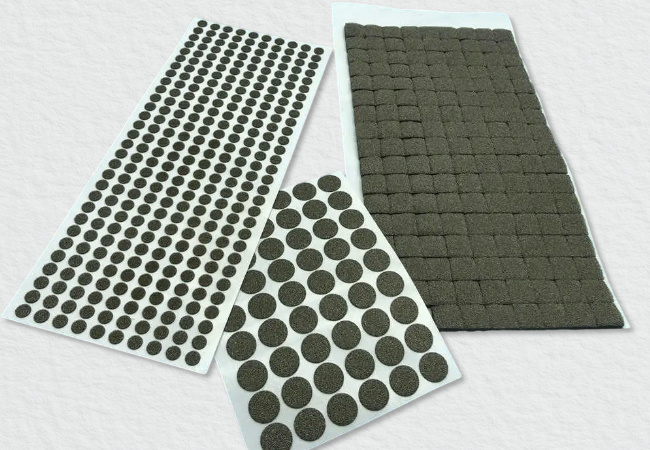
8.2. Common Die-Cut Shapes and Custom Designs
Popular shapes include rectangular pads for grounding, circular discs for connectors, and strips for gaskets.
Custom designs feature complex profiles like I/O shields or fingerstock alternatives.
Die-cutting supports holes, notches, and adhesive backing in one process.
Factories produce thousands of identical pieces quickly. This versatility fits unique enclosure needs.
It minimizes waste and speeds prototyping.
8.3. Comparison with Alternative Materials
Conductive rubber offers higher durability but requires more force and wears tools faster.
Fabric-over-foam provides excellent shielding but costs more and compresses less.
Metal springs excel in grounding but add weight and complexity.
Conductive foam balances low cost, easy cutting, and good performance.
It suits low-force applications where flexibility matters.
Many choose it for volume production over rigid alternatives.
9. How to Select the Right Conductive Foam

9.1. Electrical and Resistivity Requirements
Start by defining needed resistivity—lower for direct grounding, higher for controlled dissipation. Check if EMI shielding requires metal plating.
Match to standards like ANSI/ESD S20.20 for compliance.
Test samples for actual performance under compression. Consider if permanent conductivity is essential.
This ensures reliable protection without over-specifying.
9.2. Environmental and Mechanical Factors
Evaluate operating temperature, humidity exposure, and chemical contact.
Choose closed-cell for moisture resistance or open-cell for compressibility.
Assess compression cycles for reusable parts. Flame retardancy matters in safety-critical uses.
Mechanical strength prevents tearing in assemblies. These factors extend service life in real conditions.
9.3. Cost, MOQ, and Supplier Evaluation
Compare unit prices against volume—higher performance often costs more. Check minimum order quantities for prototypes versus production.
Evaluate suppliers for certification, lead times, and custom capabilities.
Request samples and references. Balance total cost with reliability. Strong suppliers support design and scaling.
10. Installation, Handling, and Best Practices

10.1. Storage and Handling Guidelines
Store foam in original sealed bags away from dust and contaminants.
Keep at room temperature to prevent degradation.
Use clean gloves during handling to avoid oil transfer.
Avoid sharp objects that could tear surfaces.
Label packages with date for shelf life tracking. Proper storage maintains conductivity over time.
10.2. Integration in Packaging and Assemblies
Apply adhesive-backed versions for secure placement in trays or enclosures.
Compress foam 25-50% for optimal electrical contact.
Align precisely in gaskets to close gaps fully.
Combine with grounding straps if needed.
Test fit during prototyping. This ensures effective protection in final products.
10.3. Testing and Verification Methods
Use ohm meters to check surface resistivity after installation.
Perform shielding tests for EMI applications.
Verify charge decay times meet standards. Inspect compression recovery visually.
Document results for quality control. Regular testing catches issues early.
11. Common Buyer Mistakes and How to Avoid Them
Confusing conductive with anti-static foam leads to inadequate grounding—always check resistivity specs below 10^5 ohms/square for true conductivity.
Ignoring compression effects causes loss of contact over time—select foams with high recovery rates and test under expected force.
Overlooking environmental exposure degrades performance—choose permanent volume-loaded types for humidity or temperature variations.
Selecting based on price alone risks non-compliance—prioritize certified materials that meet standards like ANSI/ESD S20.20.
Skipping sample testing results in surprises—request and evaluate prototypes before full orders.
Forgetting custom die-cutting needs limits fit—discuss designs early with suppliers for optimal shapes.